







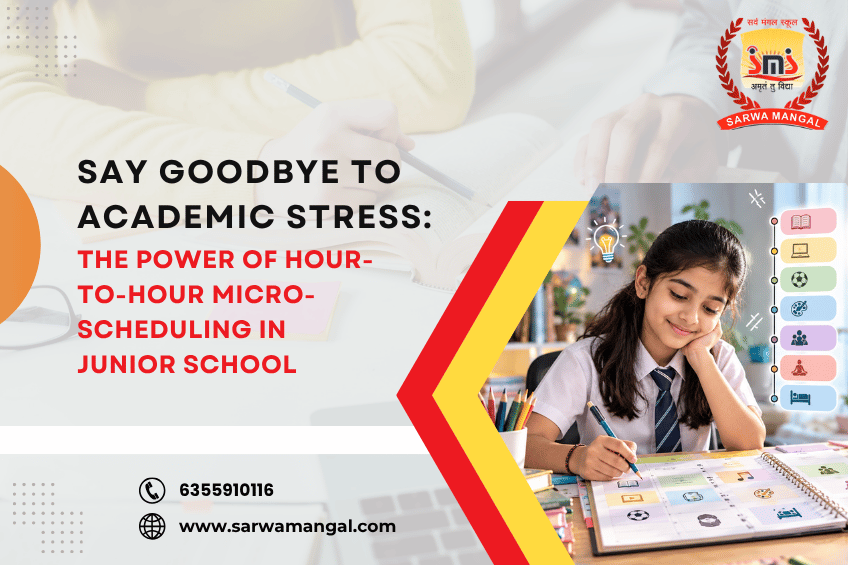
Academic stress starts earlier than most of us expect. A junior school child handles classwork, homework, reading, tests, hobbies, and playtime, all in one day. Without a clear routine, even a small task can feel heavy.
That’s where hour-to-hour micro-scheduling helps. Instead of handing your child a long to-do list, you split the day into small time blocks. There’s structure, but not every minute belongs to studies.
If you’re comparing the best GSEB school in Vadodara for juniors, notice how the school helps children manage time. A good school builds healthy study habits and still leaves room for play, rest and family. Many of us know the 5 pm scramble of tuition, snacks and unfinished homework, and a little planning can calm it down.
What Is Hour-to-Hour Micro-Scheduling?
It means dividing your child’s day into short, clear slots, each with one activity. For example:
- 4:00–4:30 pm: Snack, rest
- 4:30–5:15 pm: Homework
- 5:15–6:15 pm: Outdoor play
- 6:15–7:00 pm: Reading, revision
- 7:00–8:00 pm: Dinner, family time
- 8:00–8:30 pm: Pack school bag
- 8:30 pm onwards: Wind down
Don’t run it like a strict timetable. Think of it as a rhythm, not a rulebook.
For younger children, knowing what comes next saves a lot of mental effort. Big assignments also look less scary.
How Can Micro-Scheduling Reduce Academic Stress?
1. It Breaks Big Tasks Into Small Steps
“Finish your homework” sounds huge to an eight-year-old. Try small steps instead:
- Five maths sums
- Short break
- One chapter
- Written answers
- Pack bag
Small targets are easier to start. Work stops piling up until late evening.
2. It Separates Study From Play
Children need downtime. If homework drags on all evening, school never seems to end.
A micro-schedule gives study a clear start and finish. Once it’s done, your child can play without guilt. This helps junior students who are still building concentration.
3. It Makes Time Visible
Thirty minutes means very little to a young child. A wall clock, planner or picture chart makes time visible.
Say, “Read for 20 minutes, then play.” Slowly, they learn to manage time themselves.
How Parents Can Build a Practical Micro-Schedule
Fit the schedule to your child’s real day, not an ideal one. Begin with fixed items like school, travel, meals, tuition and bedtime. Then fill in homework, reading and play.
Keep Study Blocks Short
For junior students, 20–40 minute blocks usually work better than hours at a desk. Adjust for age and attention span.
Add Buffer Time
Don’t fill every hour. Leave 10–15 minutes between tasks, so one delay doesn’t spoil the whole evening.
Give Children Some Control
Ask simple questions:
- Reading before snack?
- Which homework first?
- When’s playtime?
Small choices make the routine feel like their own.
A Simple Example for a School Day
Take a Class 4 student who reaches home at 3:30 pm.
| Time | Activity |
| 3:30–4:15 | Lunch, rest |
| 4:15–5:00 | Homework |
| 5:00–6:00 | Outdoor play |
| 6:00–6:30 | Bath, freshen up |
| 6:30–7:00 | Reading, revision |
| 7:00–8:00 | Dinner, family time |
| 8:00–8:20 | Pack school bag |
| 8:20 onwards | Quiet time, bed |
Adjust this for your child’s commute, school timings and energy levels. On tiring days, such as after sports day or a long bus ride, it’s fine to lighten the evening.
Common Micro-Scheduling Mistakes Parents Should Avoid
Micro-scheduling backfires when it becomes another performance target.
Making It Too Strict
Missed one block? The day isn’t ruined. Shift the task or trim the workload.
Removing Free Time
Play isn’t wasted time. It helps children recharge after school.
Overloading Homework Slots
The goal isn’t more tasks done. It’s finishing important work with less worry.
Comparing Schedules
Every child learns differently. Don’t compare siblings or classmates by study hours.
How the Best GSEB School in Vadodara and Parents Can Work Together
Coordinating time is easy if teachers and parents coordinate. The teacher can inform about upcoming exams, deadlines for projects, and weaknesses. In this way, parents will change the routine at home but will not turn every evening into additional studies.
If you are choosing a school, do not choose according to the results alone. Consider these points:
- Approach to homework
- Wellbeing of the child
- Sports and activities
- Communication with parents
- The learning environment
Try to keep the balance between what the school requires and the home routine.
Frequently Asked Questions
1. Is micro-scheduling appropriate for junior school students?
Yes. The small time frames allow the children to understand what should be done next without turning the whole day into studies.
2. How long should a junior school study session be?
There’s no single right answer. Many children do better with shorter sessions and breaks than with long, uninterrupted study. Consider age, attention span, and how hard the task is.
3. Can micro-scheduling help you completely avoid academic stress?
No. Micro-scheduling avoids unnecessary stress that may develop due to bad planning and procrastination, but the child will need some direction.
4. Should you follow the same schedule every day?
Stay in a routine, yet be flexible. You might have to make adjustments on weekends, during exams, in hobby classes, and on family occasions.
5. What should parents consider in the school in Vadodara?
These include the quality of teachers, support to students, communication with parents, activities, safety, and school culture. In addition, the environment facilitates the growth of the child.
Conclusion
Academic success does not necessarily involve the child studying all day long every day. A proper schedule is important for helping children prioritize, complete their tasks, and remain children at the same time.
Micro-scheduling brings structure to a busy school day without turning home into another classroom. Start with a few realistic blocks, add breaks, and let your child have a say.
If you’re looking for the best GSEB english & gujarati medium school in Vadodara, Sarwamangal will teach your child how to combine academic achievement with confidence and independence.